Hildegard’s cosmos as an egg
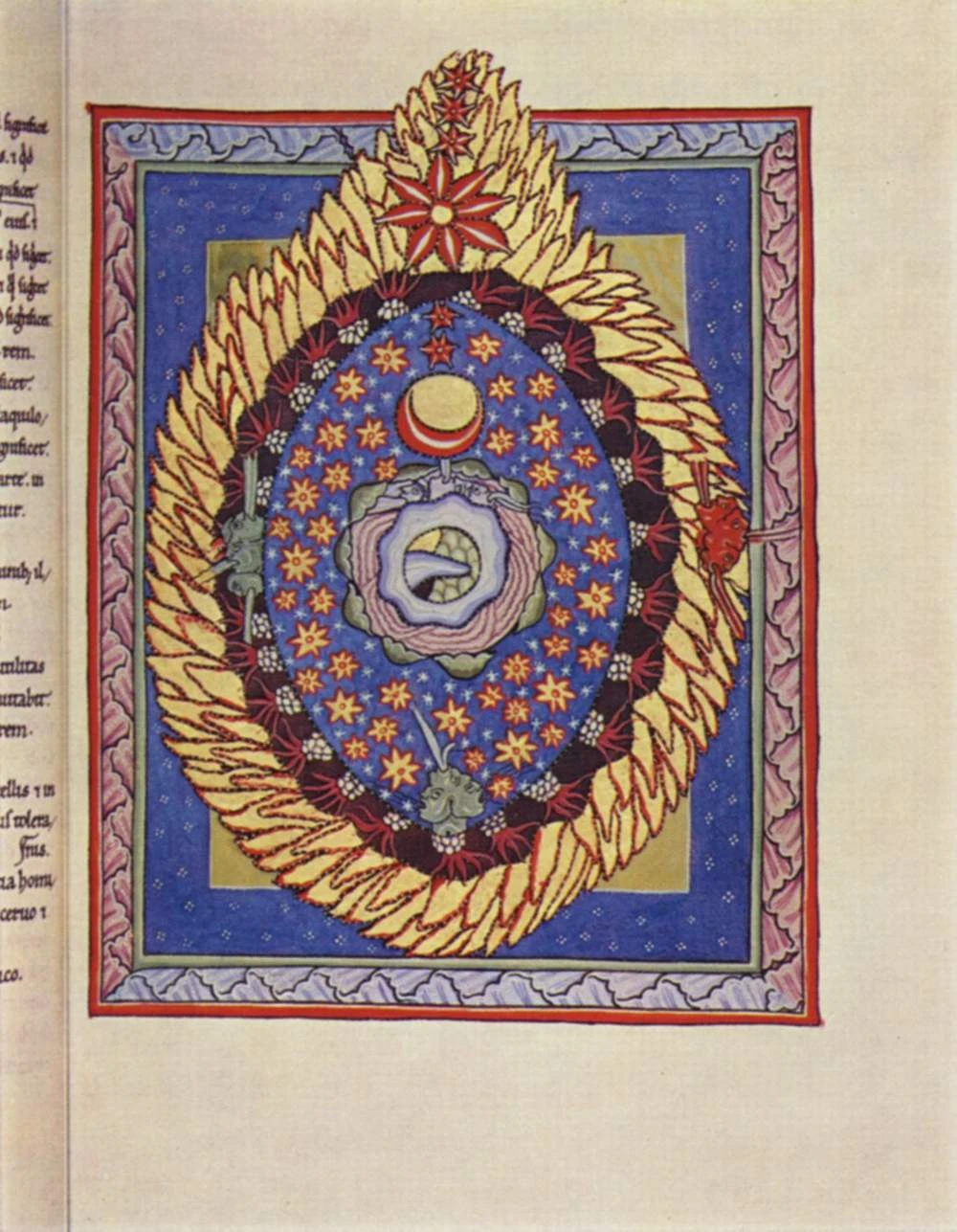
An oval cosmos encloses a small central Earth within strongly differentiated bands of color, stars, darkness, and flame. The image accompanies the third vision of the first book of Hildegard of Bingen’s Scivias. Its layered enclosure makes the cosmos look organic as well as architectural, with celestial lights embedded in a protected interior. The original Rupertsberg manuscript is missing; this familiar color image transmits its design through a later hand-painted facsimile. That distinction matters when comparing the appearance of historical pigments, surfaces, and manuscript illumination across the collection.
Reading this image
Notice the egg-shaped boundary and the contrast between fiery exterior and starry interior. Read as visionary cosmology, not a surveyed map or Earth cross-section.
Object and copy
Commons identifies an original dated c.1165, missing since 1945, preserved in a hand-made 1927 facsimile. This file is a Yorck Project reproduction of that facsimile.
Local display copy is 1,000 × 1,287 pixels; fine labels may not be legible. Open the source image for closer study.
Image & reuse
Commons explicitly marks both depicted artwork and reproduction public domain; Yorck compilation has separate GFDL terms.
Commons identifies an original dated c.1165, missing since 1945, preserved in a hand-made 1927 facsimile. This file is a Yorck Project reproduction of that facsimile.
Display: 1,000 × 1,287 pixels.
View source record ↗ · Open source image ↗Explore related motif stories in the cosmogram →
Continue looking
The substantial sphere: Sacrobosco in Italian → Apian and Frisius: the division of the spheres → Fludd’s wedge of metaphysical spheres → Follow journey →